
I Found Out I Had ADHD at 52. The Relief Was Real. So Was the Grief.
This is the first article in the Inner Reinvention series — where we do the inside work: mindset, identity, emotional wellbeing, and learning to trust yourself again. If you've ever wondered whether something is fundamentally wrong with you, you're exactly who this series is for.
There's a specific kind of shame that lives in a work-from-home afternoon.
No boss looking over your shoulder. No coworkers nearby. Just you, your laptop, a full list of things to do — and an absolute inability to start any of it.
I sat on my couch like that more times than I can count. Laptop open. Video calls scheduled. A voice in my head that kept asking:
"How can you advise successful executives on productivity when you can't even make yourself productive?"
That thought didn't stay small. It never did.
It became a shame spiral. Which became paralysis. Which became more shame about the paralysis.
I cataloged every piece of evidence that I was a fraud. Then I beat myself up for cataloging it instead of working. Then I beat myself up for that.
I had been doing this for years. I just didn't have a name for it yet.
A podcast conversation changed everything
A few months ago, at 52, I was talking with one of my podcast guests — a psychologist — about some of my quirks. Mid-conversation, she paused and asked:
"You know that's an ADHD trait, don't you?"
I did not.
It was like a cartoon light bulb switched on over my head. Suddenly, so much of my life made sense.
She walked me through a series of questions that confirmed what she suspected. And she explained something I hadn't known: ADHD comes in different flavors. Different expressions. That's why I hadn't recognized it in myself — even though every other member of my family has it.
I was 52 years old. A few months into early retirement. Building a business. Still navigating perimenopause. Supporting my husband and his business. Parenting a teenager at home.
I had already been living through burnout, identity shifts, and a complete rethinking of how I wanted to work and live.
And then, in one conversation, I was handed language for patterns I had spent a lifetime blaming on my character.
The diagnosis brought relief. It also brought grief.
The relief was immediate. For the first time, I wasn't looking at my life through the lens of failure. I was looking at it through the lens of understanding.
The grief took longer.
I thought about the relationships I had let wither because I didn't understand how my own brain worked. The projects I'd meticulously planned and never started. The years of shame spirals that kept me up at night, replaying old mistakes, cataloging old evidence that something was fundamentally wrong with me.
I thought about the fact that I had spent years working in HR — leading Belonging programs — while never truly feeling like I belonged. Helping other people feel seen and supported while quietly white-knuckling my own way through every single day.
The diagnosis explained so much:
Why I was so easily overstimulated, and how that could send me into full shutdown.
Why I could plan a project beautifully and still completely freeze at the starting line.
Why I chased shiny objects and struggled with distraction.
And — on the flip side — why I could hyper-focus so intensely that I ignored deadlines, notifications, hunger, and my own body's needs for hours without even realizing it.
None of this was laziness. None of this was weakness. It was just how my brain worked.
But knowing that didn't automatically fix it.
This is the part we don't talk about enough
Most people treat a diagnosis like a finish line. Like the moment you finally have a name for what you've been carrying, everything gets easier.
But that's not how it works.
The diagnosis gives you language. It does not do the healing, the unlearning, or the experimenting for you.
Awareness is powerful. But awareness alone is not support.
And this is where so many women get stuck. We expect the diagnosis to hand us a solution, when what it really gives us is a starting point.
Three myths I had to unlearn
Myth 1: My problem was discipline.
This one kept me trapped for years.
I was the procrastination queen. I could build detailed, organized, color-coded plans. But actually executing them? That was the impossible part. Task initiation — that's what it's called — was my kryptonite.
Every time I couldn't start, I made it mean something terrible about me. I told myself I was lazy. Unmotivated. Failing.
But the truth wasn't that I lacked discipline. The truth was that I needed support getting started. That shift alone — from I'm failing to I need a different kind of support — changed how I see my entire life.
Myth 2: I just need better systems.
This is such an easy trap for smart, capable women.
We try new planners. New routines. New productivity methods. New color-coded everything. And when those systems fail, we blame ourselves.
But if you don't understand the underlying problem, you're solving for the wrong thing. The issue isn't that you need more systems. You need systems that actually fit your brain, your body, and your capacity.
Myth 3: Now that I know, I should function better immediately.
Even with clarity, there's still a learning curve.
There are different expressions of ADHD. Different triggers, needs, and patterns. You still have to get curious about your own specific wiring — what sends you into paralysis, what helps you begin again, what your nervous system actually needs to feel safe enough to function.
Diagnosis gives you a map. It doesn't walk the path for you.
If you're seeing yourself in any of this — I want to hear from you. Drop a comment on any of our socials[links below]. These conversations matter, and so does yours.
The mindset shifts that changed everything
The biggest one: moving from What's wrong with me? to What support do I need?
That question changed everything. When you stop reading your struggle as a moral failure, you can finally start building real support.
I also had to stop forcing neurotypical systems and start building around my actual capacity. This shift played a bigger role in my decision to leave corporate than I've ever fully acknowledged. I had spent years trying to meet expectations that didn't account for how I actually function — even while leading programs designed to make others feel they belonged. I was helping create belonging for everyone but myself.
And I had to let go of the belief that productivity equals worth. Capacity gets a vote. My output may not look like someone else's output. That doesn't make it less valid.
These weren't small tweaks. They were the beginning of self-trust.
What actually helps me now
The diagnosis didn't fix my life overnight. But it helped me get more intentional about support.
What that looks like for me:
Therapy. Being able to bring this new understanding to my therapist allowed her to better tailor our sessions. Years of work suddenly had new context.
Community. After leaving corporate, I had almost no community. Understanding my neurodivergent needs meant being able to seek out spaces where I'd actually feel understood and accepted.
Boundaries. I can now communicate my needs more clearly, which makes it easier to set and protect the right boundaries for me.
Rest without guilt. I have the permission now. It took a while to actually believe it.
Nervous system support. Knowing how to set up my environment, pace my days, and recognize my own warning signs before I spiral.
Letting my family help. Meals, chores, logistics. I stopped treating this like a personal failure and started treating it like smart resource management.
Support doesn't have to be dramatic to be life-changing. Sometimes it's therapy. Sometimes it's asking your teenager to handle dinner.
Reset rituals for the hard days
When I'm overwhelmed, frozen, ashamed, or just completely unable to start — these are the things that actually help:
A walk. Not just for fitness. For a full reset — brain, body, environment. I do some of my best thinking, deeply and creatively, when I'm out walking.
A timer. Two ways: a short one (15–30 minutes) to help me start something I'm dreading, because knowing it's time-limited makes it feel less impossible. And a longer one (60–90 minutes) during hyper-focus, so I remember to eat, move, and exist.
Changing environments. I do this several times a day — home office, favorite chair, dining table, kitchen counter. This matters for my body physically (chronic pain flares if I stay in one position too long), and it resets my focus every time I switch.
A minimum viable day. For when capacity is genuinely low and I need a floor, not a ceiling. What's the smallest version of today that still counts?
Writing down one next step. Not the whole project. Not the plan. One step. When task initiation is the problem, I'll even put the task into an AI tool and ask it to give me the smallest possible next move. That one nudge is often enough to break the freeze.
Protein, hydration, rest. Before my body shuts down. I've learned the hard way that I don't notice I'm running on empty until I've already hit the wall.
Stepping away before spiraling. I learned this in therapy: recognize the physical signs that you're getting overwhelmed, and do something different before it gets worse. Not after.
None of these are magic. They're support. And support is what makes self-trust possible again.
What I want you to know
If you're a midlife woman with a late ADHD diagnosis — or you suspect you might be neurodivergent — or you're in burnout recovery and starting to reinterpret your whole life through a completely different lens:
You are not broken.
You are not lazy.
You are not failing.
You may simply need to understand how your own brain and nervous system work so you can give yourself what you actually need.
That is not weakness. That is wisdom.
If this resonates, I'd encourage you to pursue a formal diagnosis if that feels supportive. And wherever you are in this journey, you don't have to figure it out alone.
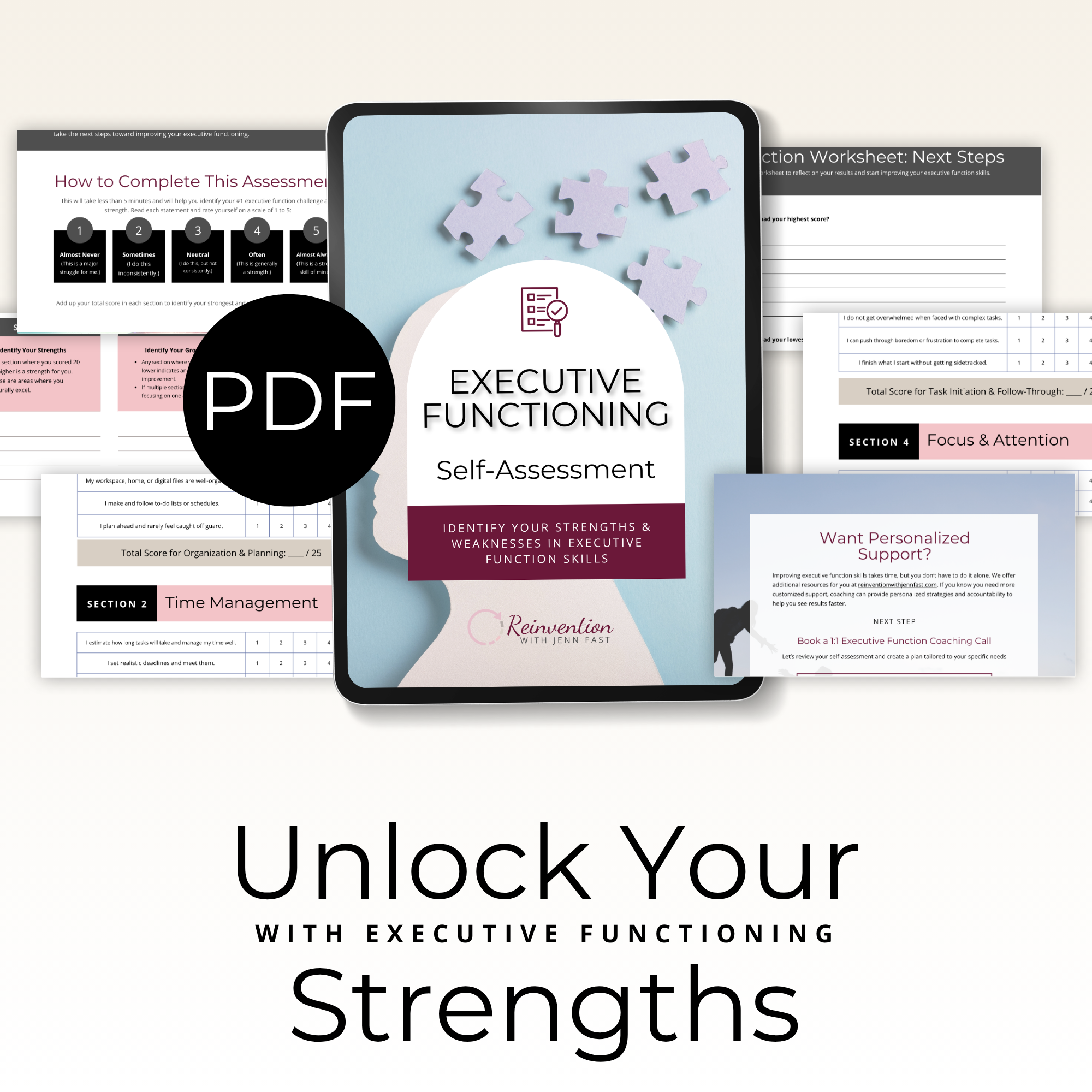
I created a free Executive Function Self-Assessment to help you understand how your executive functioning is showing up right now — and where you might need more support. It's a great starting point, whether you have a diagnosis or not.
And if you want to keep going deeper — subscribe below. Every new article comes straight to your inbox.
Coming up in this series:
Perimenopause and ADHD: Why bad brain days aren't a character flaw
The art of the minimum viable day — building real rhythms when capacity is unpredictable
Rest as resistance: why "doing less" might be your most strategic move
Reflection prompt
If you stopped reading your struggles as character flaws and started asking "what support do I need?" — what's the first thing you'd ask for?
Resources
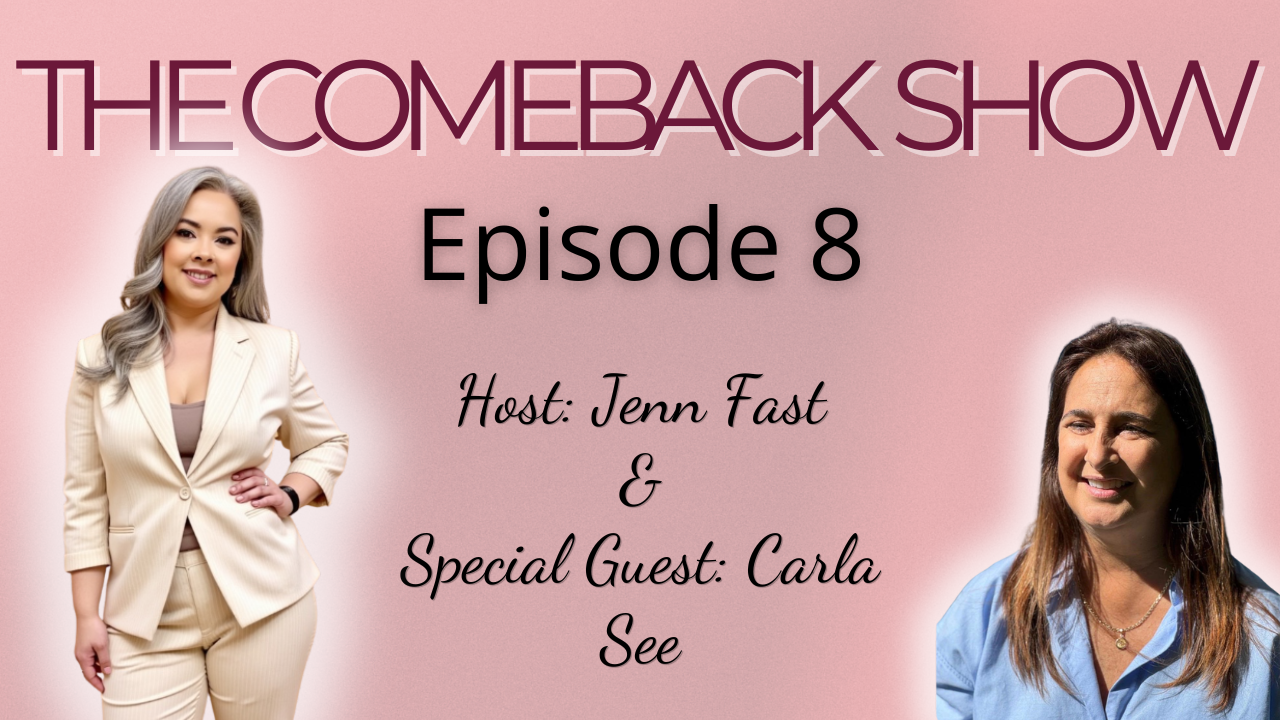
If you're navigating your own ADHD diagnosis and/or parenting a neurodivergent teen — or if you want to understand executive function more deeply after reading this — I want you to hear my latest conversation on The Comeback Show. My guest Carla See is an executive function coach who works with ADHD teens and their families, and what she shared applies just as much to the adult in the room as it does to the kid. Click on the link for the show's home page and make sure you're subscribed so you don't miss the episode when it drops.
Some days I still sit down at my laptop and feel the old freeze coming.
The difference now is that I don't make it mean something terrible about me. I know what's happening. I know what I need. And I know how to begin again — even if "beginning again" looks like a 15-minute timer, a glass of water, and moving to a different chair.
That's not a failure story. That's a support story.
And if you're somewhere in the middle of yours — just diagnosed, newly curious, or quietly reinterpreting a lifetime of struggle through a brand new lens — I want you to know that the beginning is the hardest part. Not because everything gets easy after this, but because you finally have something you didn't have before.
Language. Understanding. A place to start.
That's enough.
-Jenn Fast


