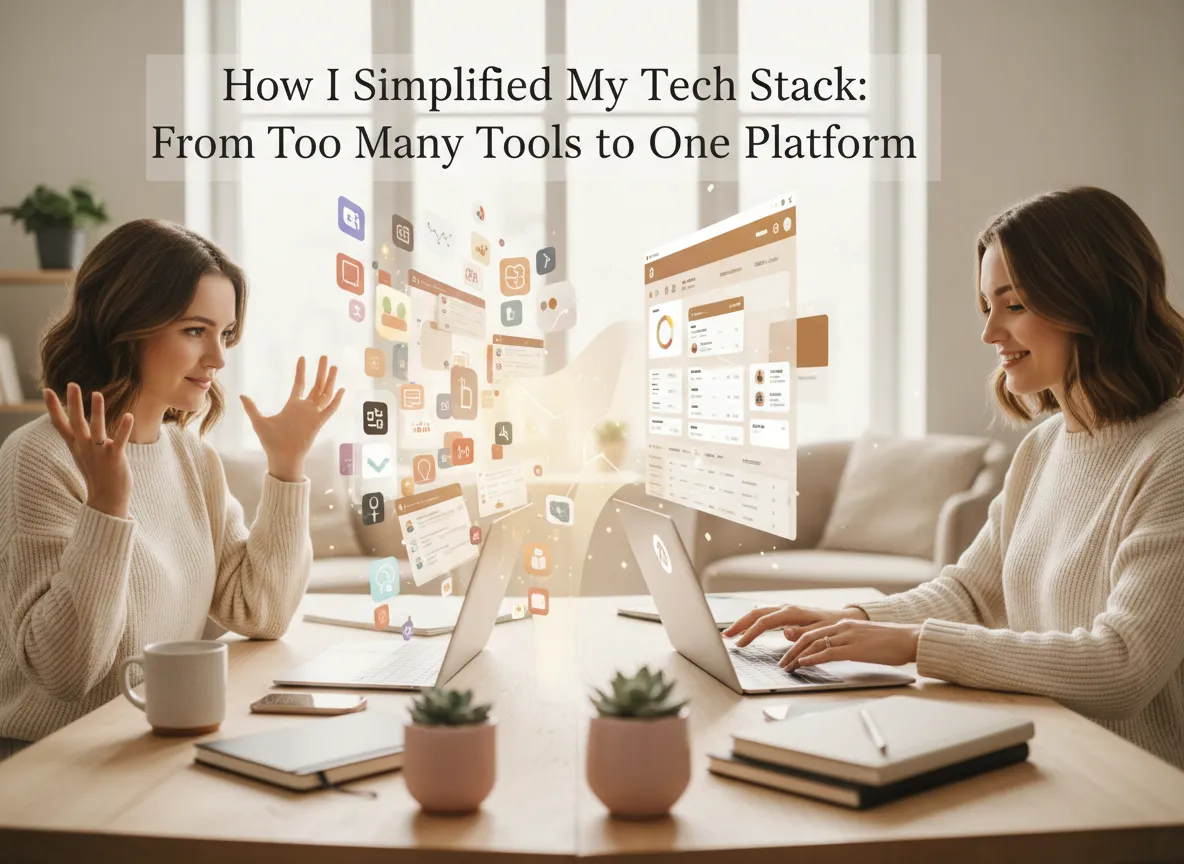
How I Simplified My Tech Stack: From Too Many Tools to One Platform
If you’ve been around here for a while, you know I believe reinvention happens from the inside out.
That means we tend to our health. We rebuild self-trust. We create rhythms that support our real lives. And then, from that steadier place, we begin expanding outward—into our work, our relationships, our communities, and the life we’re building in the world.
That’s what Outer Reinvention means to me.
And in this series, I’m taking you behind the scenes of my own entrepreneurial journey—not the polished version, but the real one. The messy middle. The systems. The lessons. The things I’m still figuring out as I go.
This post is the first in that series.
The Moment My Stomach Dropped
I was sitting in my favorite chair in the living room, laptop open, spreadsheet up, doing the kind of business admin that feels both responsible and deeply unsexy.
One of the perks of being your own boss is that you can do your P&L from a cozy chair instead of a cubicle. The less glamorous part is what happens when the numbers tell the truth.
I was adding up my monthly business subscriptions when my stomach dropped.
Not in a dramatic, movie-scene kind of way. More like that quiet, sinking feeling when you realize something has been draining you for longer than you wanted to admit.
I was spending far more than I thought on platforms, tools, and software. And I was doing it while trying to figure out whether I could afford to join an association for female entrepreneurs.
So yes, I felt guilty.
But the truth is, the money wasn’t even the hardest part.
The hardest part was realizing how much I had started to dread content creation when I used to love it.
At that point, I was still juggling three separate brands. I was hopping from platform to platform, trying to remember where everything lived, what connected to what, and what still needed to be done.
And I kept thinking the same things on repeat:
There has to be a better way to do this.
Can’t one platform just do all this?
Do I really need all of this?
That was the moment I knew this wasn’t just a budgeting issue.
It was a capacity issue.
When Your Tools Start Running You
Before I simplified, I was juggling 14 different tools and platforms.
Some of them were excellent. Some of them were necessary. Some of them overlapped. None of them were the villain on their own.
But together? They were a lot.
Here’s what my stack looked like at the time:
Descript and CapCut for video editing
Canva for graphics
Kit for email, landing pages, and forms
WordPress for my website and blog
QuickBooks for finance
SocialBee for scheduling and analytics
Substack for my newsletter and podcast
Calendly for booking
Etsy for my online store
Google Workspace for email, calendar, and cloud storage
Sintra AI for AI support
Plus I was considering tools like ManyChat and Zapier for more automation
None of that is inherently wrong. This is not a “never use tools” sermon.
But for me—as a neurodivergent solopreneur trying to build sustainably and protect my energy—it had become too much cognitive overhead.
Creating social media content often meant using one tool for ideation, another for graphics, another for scheduling, and then manually posting anyway because the scheduler was buggy or didn’t support every platform the way I needed it to.
My email subscribers were spread across multiple places. My website, blog, and newsletter ecosystem weren’t talking to each other cleanly. I had no CRM. And when it came to longer-form content like podcasts and YouTube videos, the workflow felt so cumbersome that I started avoiding the very work I most wanted to be known for.
That was the red flag.
When the systems you chose to support your business start making you avoid your actual work, something needs to change.
The Shift
Around that same time, I got a special offer through the same women’s entrepreneur association I originally wanted to join, that included access to an all-in-one business platform.
And when I realized that one platform could replace most of my stack at a lower monthly cost, it felt like one of those rare business decisions that was both practical and obvious.
Yes, money mattered.
But honestly? My time and sanity mattered more.
I was no longer willing to keep paying that much money and still feel scattered.
I was no longer willing to let tool chaos suck the joy out of work I care deeply about.
And I was definitely no longer willing to keep building without a clear view of what was actually working.
What I Needed Wasn’t More Tech
What sold me wasn’t the fantasy of the “perfect” system.
It was the possibility of having one login, one learning curve, one support system, and one place where the moving parts of my business could finally talk to each other.
That mattered more than I can explain.
Because when you’re already managing your energy carefully, every extra login, every disconnected workflow, every “where did I put that?” moment takes something out of you.
The platform I chose gave me a place to manage:
CRM and customer records
email list and automations
newsletters
landing pages, forms, and surveys
customer payments, invoicing, and estimates
website and blog hosting
online shop management
social media scheduling
analytics and dashboards
booking calendar and messaging
sales pipeline
workflow automations
membership community features
It also came with tutorials, AI support, human support, and templates—which mattered because I wasn’t looking for more complexity dressed up as efficiency.
I was looking for a system that fit the way I actually work.
That’s a very different thing.
What My Stack Looks Like Now
Now, I do almost everything inside that one platform.
Not everything. Almost everything.
And I think that distinction matters, because this isn’t a minimalist fantasy where one app magically does it all forever.
I still keep a few tools that genuinely earn their place:
Substack for podcast hosting, because it’s free and syndicates to podcast platforms
Canva for design, since the templates I use are editable there
Descript for podcast and video editing, because it’s flexible and feature-rich
Sintra AI for AI help, because it’s especially well trained on my voice, business, and style
Google Workspace, which now integrates cleanly into the rest of my workflow and my new platform
So no, I didn’t reduce everything to one single app.
But I did go from 14 tools to 6.
And that shift has saved me about $150 per month and, by my estimate, more than 10 hours a week.
That is not nothing.
That is real money, real time, and real mental space.
What Got Easier
The biggest difference is not just logistical. It’s emotional.
I don’t dread creating the way I used to.
Creating and scheduling content is dramatically simpler.
If I have an idea for a post, I can drop the caption into my main platform, upload the image or video, use integrated AI to adapt the messaging for different platforms, and schedule it without bouncing all over the internet.
Launching products is easier too.
Before, I would procrastinate creating new digital products because I knew it meant building landing pages, order forms, and funnels across multiple systems.
Now my website, shop, product setup, forms, and customer flow live in one place. I can test things before they go live, fix problems faster, and make decisions based on real data.
And maybe most importantly, I can actually see what’s happening in my business.
I can see subscriber growth, follower growth, what’s driving traction, what platforms are performing, and how individual customers are moving through my ecosystem.
That kind of visibility matters.
Not because I’m trying to obsess over metrics, but because data can support self-trust too. It helps me stop guessing. It helps me make cleaner decisions. It helps me see that my work is actually going somewhere.
And because I no longer dread the process of creating and posting, I’m putting out more content more consistently—and with more quality.
That means I get to spend more of my energy on building, messaging, the story, and the actual creative work.
Which is the whole point.
What’s Still Clunky
I want to be honest about this part too, because I never want to sell you a fantasy.
The transition was not instant.
It took several months to migrate everything. Some data and features didn’t transfer perfectly. A few links broke. Some things had to be rebuilt. And there are still features I haven’t fully explored because, like most solopreneurs, I am learning while running the business at the same time.
A few areas still feel clunky, especially newsletters and membership setup.
And yes, there is always the concern that a platform could raise prices, change direction, or eventually stop serving your business well. That’s real.
But even with those caveats, simplifying has reduced my overwhelm more than I expected.
That alone made it worth it.
Why This Matters for Burned-Out Women Building Businesses
A lot of women in my audience are not struggling because they’re lazy, behind, or “bad at tech.”
They’re overwhelmed.
They’re trying to rebuild after burnout. They’re carrying imposter syndrome. They’re intimidated by the idea of learning five new systems at once. And many of them quietly believe they might be too old or not smart enough to figure it out.
I don’t believe that for a second.
You are not too old to learn new technology.
But you also do not need to learn every tool on the internet.
You need the right tech for your business, your goals, and your actual way of working.
That’s the reframe.
You don’t need to learn all the new tech. You need to learn the right tech for what your business needs and how you work.
That is what capacity-aware business building looks like.
Because the right tools don’t just save time now. They create more time, more clarity, and more automation later. They make it easier to follow through. Easier to trust yourself. Easier to keep going.
And for women rebuilding after burnout, that matters.
A Gentle Audit for Your Own Business
If your current stack is making your business heavier instead of more supported, this is your permission slip to pause and reassess.
Here’s where I’d start:
Make a list of every platform you’re currently paying for.
Write down what each one actually does for your business.
Circle the features you truly use or expect to use soon—not the ones you might use someday.
Make a list of what your dream platform would need to do.
Use AI to compare platform options by pricing, features, and ease of use.
Look for opportunities to consolidate without sacrificing what matters most.
Simpler does not mean smaller.
Simpler can mean more sustainable.
And sustainable is sexy, actually.
Let’s Crowdsource This
I’m intentionally not naming the platform publicly in this post for business reasons.
I want to be transparent about that.
It’s a referral-only platform, and they don’t currently offer a discount for new subscribers or commissions for referrals. That doesn’t sit especially well with me, so I’m not interested in publicly sending traffic their way without reciprocal value for my community.
But the bigger point of this post isn’t the platform name anyway.
It’s the principle.
If you do your own tech stack audit, I’d love to hear what you find.
What tools are earning their keep?
What feels heavier than it should?
Where could consolidation save you money, time, or mental load?
Share your thoughts in the comments. Ask questions. Recommend platforms you love. Let’s crowdsource one of the biggest struggles new entrepreneurs face.
A Few Helpful Resources
If you’re in a season of rebuilding, simplifying, or learning new systems, here are a few resources worth checking out:
Everyday Balance Bundle - a free collection created for women who are juggling full lives and want to feel more grounded in the midst of it all. I’ve contributed two resources of my own.
March Freebie Bonanza — link coming soon
Aligned Life Summit - a free 5-day virtual experience for women who are tired of holding it all together… and ready to create a life that actually feels aligned. My presentation is titled “Aligned Productivity After Burnout” and I’ve also contributed a free resource.
And if you want more behind-the-scenes entrepreneurship reflections like this, make sure you’re subscribed and following along. This is just the beginning of the Outer Reinvention series.
We’ll keep exploring business building, sustainability, and what it looks like to reinvent from the inside out—alongside Inner Reinvention and Reinventing Health, because all of it matters.
If you missed the earlier posts in this philosophy, you can also revisit:
Inner Reinvention: My Sunday Reset Ritual to Recover from Burnout
Why Holistic Health Matters: The First Step in Your Reinvention Journey
Reflection Prompt
What’s one tool, subscription, or workflow in your business that’s creating more stress than support right now?
You don’t need a perfect stack.
You need one that supports the business you’re building—and the woman building it.
That counts.


