How to Rebuild Self-Trust in Midlife
This one belongs to the Inner Reinvention series, where we keep coming back to the quiet, unglamorous work of becoming someone you actually trust. If you have ever caught yourself optimizing your own downtime, this is for you.
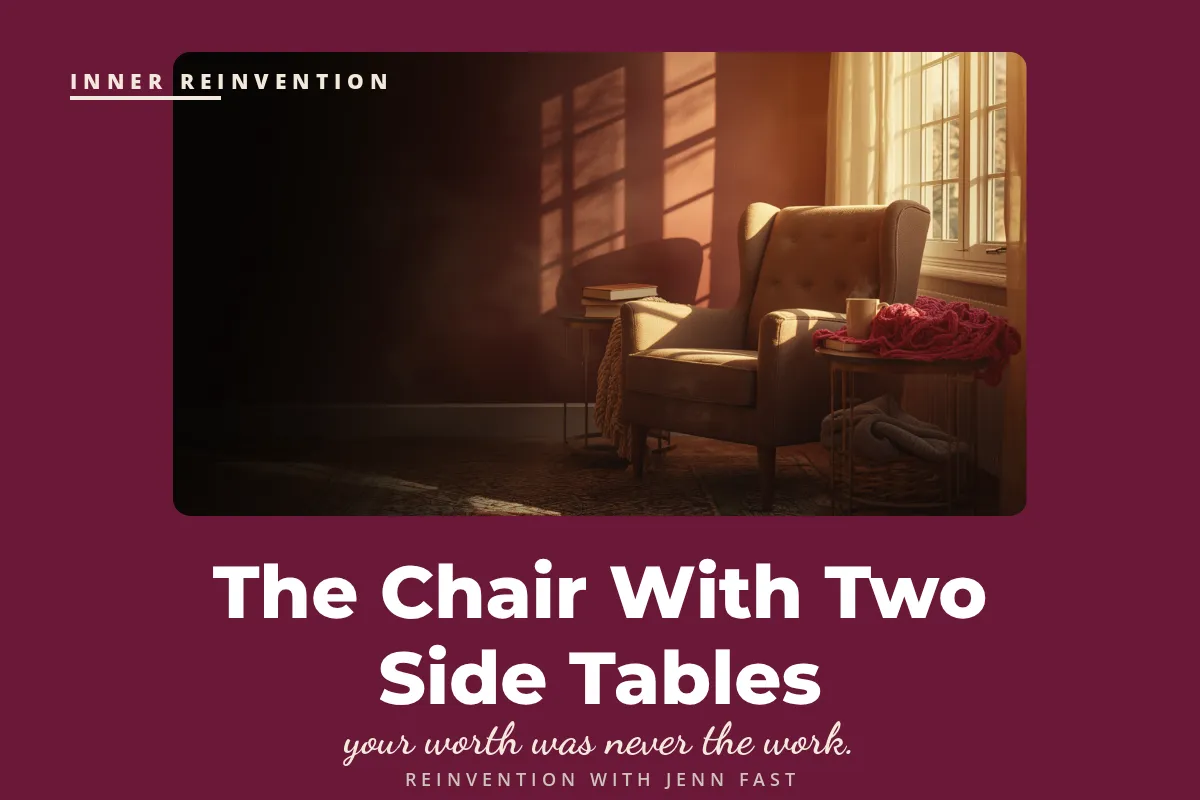
There is an armchair in my living room that tells you everything about who I used to be.
It is my chair, apart from the sectional sofa where my husband sits in the evenings while he watches TV. Except I do not just sit. I have a side table on my left and a side table on my right, because one is not enough to hold all the things I might need to keep my hands busy while I “relax.” The crochet. The coloring. The laptop, in case a thought arrives that I cannot let go of.
I built myself a cockpit for resting. And it took me an embarrassingly long time to notice what that meant.
When even your free time becomes a performance
I have been thinking about this a lot since a conversation I had on the latest episode of The Comeback Show. My guest, Miriam Brait, is a psychologist who works with high-functioning women, and she said something that landed in my chest and stayed there. She talked about how we have turned ourselves into “human doings” instead of human beings. How even our free time gets weaponized. We do not actually rest. We schedule the hobby. We optimize the downtime. The break becomes one more thing to perform.
I laughed when she said it, the way you laugh when someone reads your mail.
Because here is my version. I lie down to nap and my brain will not slow down. It keeps handing me the list, all the things I supposedly need to do, even when I have already captured every single one of them somewhere safe. So eventually I get up. I cannot just watch a show. I cannot sit empty-handed next to the person I love on the sofa. I have to be producing something, even in the one part of the day that is supposed to ask nothing of me.
And when I see a light day on my calendar, my first thought is never “how lovely.” It is “what should I do with all that time?”
That is not a scheduling quirk. That is a self-worth setting. Miriam named the difference better than I ever had. Conditional self-worth is the version that has to be re-earned every single day through output, productivity, the right answer, looking good in the room. Unconditional self-worth is the quiet knowledge that you are a human being, that your rest does not have to be earned, that work is a tool and not your identity. Or as Miriam put it:
“I don’t serve work. Work serves me.”
Most of the high-achieving women I know have one of those turned way up and the other one missing entirely. I was one of them for thirty years.
What not trusting yourself actually looked like
I want to be honest about the before, even the parts that are a little embarrassing.
In my corporate years, not trusting myself looked productivity. That is the sneaky part. It did not look like doubt. It looked like diligence.
It looked like filling my calendar with stakeholder meetings so I could collect input on literally everything I was working on, because surely the decision was safer if enough other people had touched it. It looked like oversharing with my boss, narrating every move so he could be reassured I was doing all the things. The irony is that he had no doubt at all. He sometimes begged me to slow down. The lack of trust was never coming from him. It was coming from me, and I was outsourcing it to anyone who would hold it.
And it did not stay at work. To this day I will catch myself reaching for a second opinion from my family on something I am fully capable of deciding on my own. Those moments are getting rarer as my self-trust comes back online. But they still show up, and I have stopped pretending they do not.
The quiet moment the performing stopped working
People expect the dramatic turning point to be the cardiologist’s office, where I was 35 pounds heavier, with a heart condition and cholesterol through the roof, being asked to choose between my career and my heart. That moment was real, and I quit days later.
But the quieter turn, the one that actually broke the spell, came between those two events and stung more.
I overheard our CEO ask my boss why I had even been invited to a celebration marking the close of a successful fundraising season. A season I had carried for months. I was the first one to show up to every event and the last one to leave, and I had sat across from this man in regular meetings the entire time.
And he did not know what I had done.
I stood there and felt the whole equation collapse. I had worked too hard, for too little, in a place that was never going to see it. Not because I had not done enough. Because no amount was ever going to be the amount. The performance had a ceiling, and I had just hit my head on it.
If you are nodding right now, I would love to hear your version. What was the moment you realized that performing harder had quietly stopped paying you back? You are not the only one who has hit that ceiling.
The pattern I used to call destiny
Here is the one that took me longest to see, and it had nothing to do with work.
All my life, through three marriages, I told myself the same tidy little story: “my picker is broken.” That was my explanation for everything. Bad luck. Bad taste in men. Just who I end up with.
It was only in therapy that the obvious finally got through to me. I was the common denominator. In every single one of those relationships, the one constant was me.
Miriam and I talked about this exact thing, because attachment does not just shape how we behave inside a relationship. It shapes who we are drawn to before the relationship even starts. The pattern is not destiny. It is programming. And programming can be updated.
That realization changed how my third marriage went, in real time. As things were circling the drain, my husband and I both said out loud that we did not actually want it to end. We wanted to stop fighting. And we both understood something that surprised us: these patterns were going to follow each of us into whatever came next. It would be a shame to blow up the relationship we had over behaviors that were just going to reappear in the next one. Far better to stay and fix the thing in front of us than to promise we would get it right later, with someone else.
We chose the harder, less dramatic option. We chose to update the programming instead of changing the cast.
What rebuilding self-trust actually looks like now
None of this turned into a personality transplant. I did not wake up trusting myself. I built it back the way you build anything when your brain resists starting: small, concrete, and on the record.
When I make a business decision now, I capture it immediately. I write down what I decided and why. That way, when the old doubt shows up three weeks later asking me to relitigate everything, I have a receipt. I can read my own reasoning back to myself instead of starting from scratch.
I also keep a running log of wins, big and tiny. It is evidence. Proof, in my own handwriting, that I do make good calls and that what I am doing is working. ADHD brains are wonderful at deleting the wins and saving the failures, so I keep the record manually, on purpose.
When an old pattern flares, I have one question I ask myself: “Do you actually need to outsource this decision, or are you just not trusting that you already know the answer?” Most of the time, I do already know the answer. The question just gives me permission to act on it.
And when I slide into a shame spiral, which still happens, I remind myself of everything I have or had stacked against me, and that perfection was never the assignment. Showing up authentically and consistently is the whole job. That is all that is required of me.
Why this hits different for neurodivergent women
If you are neurodivergent, or moving through perimenopause, or both like me, this is not a willpower problem and I will not let you treat it like one.
My brain does not have an off switch I am refusing to use. It genuinely will not slow down on command, which is exactly why I cannot just lie down and nap, and exactly why the chair has two side tables. The drive to keep my hands busy is not laziness inverted. It is a nervous system that learned, a long time ago, that stillness was not safe and worth was something you earned by output.
The work is not forcing the brain to be quiet. The work is telling it, over and over, that it is allowed to rest before the list is done. That the nap does not have to be deserved. That a Saturday afternoon doing nothing is not a withdrawal from some account I have to pay back later.
For us, self-trust is not a feeling we wait to arrive. It is a practice we install, one small receipt at a time.
This is not indulgence. It is strategy.
I need you to hear the reframe, because it is the whole thing.
Resting before you have earned it is not laziness. It is not falling behind. It is the strategy that lets you actually keep going. Trusting your own decision instead of polling five people first is not reckless. It is the muscle that everything else in your reinvention is going to lean on.
You are allowed to be a human being and not a "human doing."
You do not have to perform your way into deserving your own life.
Where to start, if you are where I was
Do not overhaul everything. Pick only one thing.
Start a wins log today. One line, one win, however small.
Or take one evening this week and sit in the chair with nothing in your hands. No crochet, no laptop, no second side table. Just sit, and let it be deeply uncomfortable, and notice that nothing bad happens.
That discomfort is the old programming noticing it is being updated. Let it.
A question to sit with
Not a to-do. Just something to carry around this week:
If your worth were already settled, already yours, with nothing left to prove, what would you let yourself stop doing?
Sit with it. You do not have to answer it today.
Resources
The Self-Trust Reset Challenge (free, 5 days): a short guided reset for the woman who knows performing harder is not the answer but is not sure what is. If this article landed, this is your next step. [Start the challenge →]
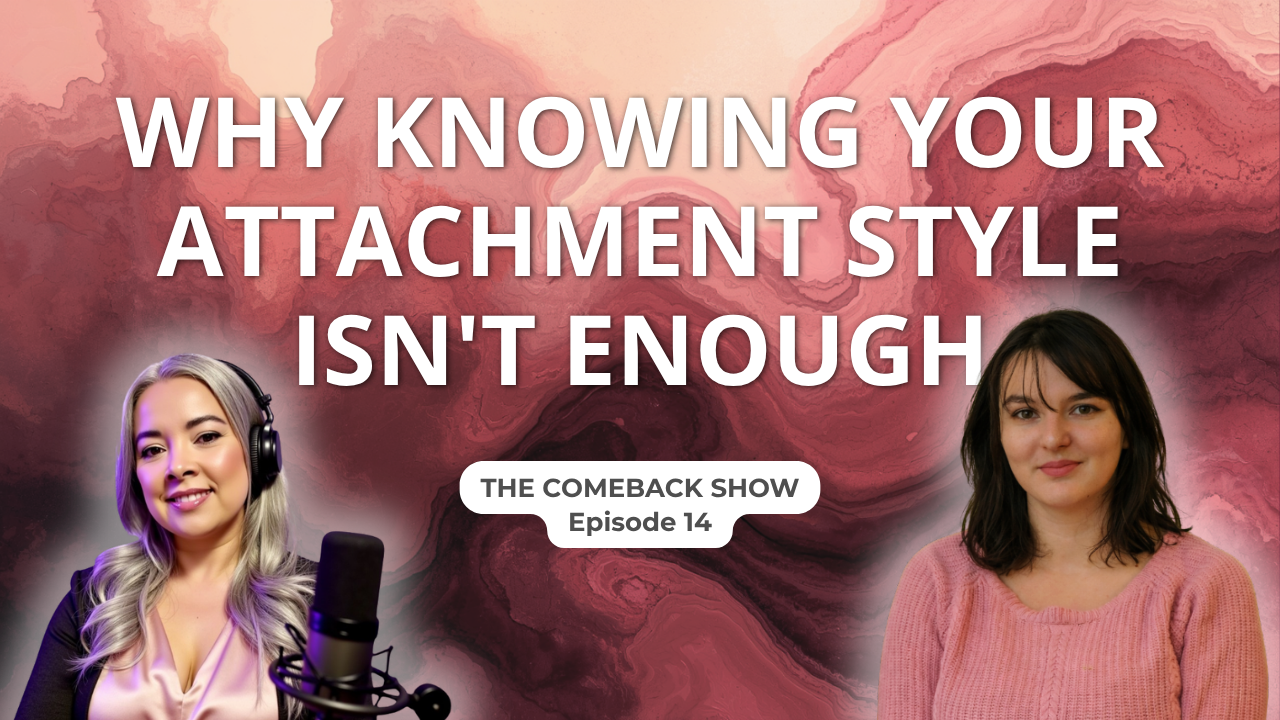
The full episode with Miriam Brait on The Comeback Show: Why Knowing Your Attachment Style Isn’t Enough. [Listen here →]
The Comeback Letter on Substack: [Subscribe →]
Come into the Reinvention Revolution community and tell me about your version of the chair with two side tables. [Join us →]


