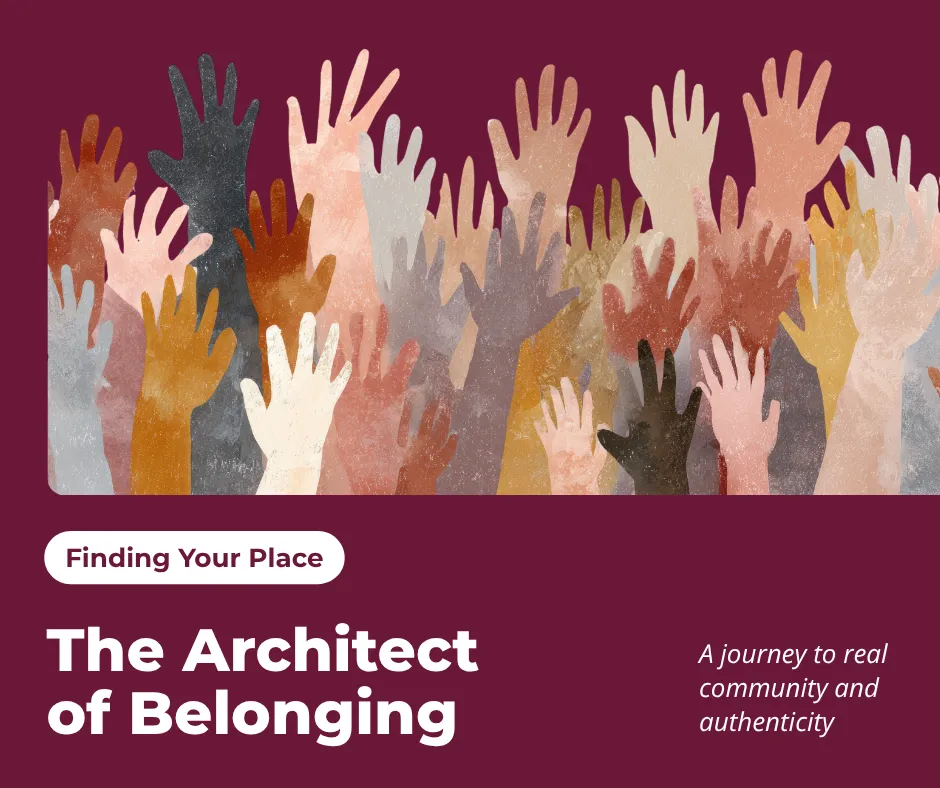
I Built Belonging Programs for Others — But Couldn't Find It Myself
For the last three years of my corporate career, one word showed up in my job title, my team's name, my strategic priorities, and my annual performance goals.
Belonging.
I was the person responsible for it. The programs, the strategy, making sure hundreds of colleagues felt seen, included, valued — like they mattered to the place they showed up every day. It was meaningful work. I believed in it. And I was, by most measures, good at it.
The only problem was that I didn't feel it myself.
The Irony I Couldn't Name for a Long Time
Not really. Not in the way I was designing it for others. I spent years surrounded by hundreds of colleagues and felt, underneath the meetings and the milestones and the momentum, a persistent sense of not-quite-fitting. Like I was playing a role written for someone else, in a room I couldn't figure out how to inhabit.
I kept thinking: if I worked harder, contributed more, aligned better — eventually the feeling would catch up with the reality. It didn't.
The belonging piece was the most visible contradiction. I could articulate what belonging looked like in a presentation. I just couldn't seem to find it in the hallway. And there's something particularly disorienting about being the person responsible for a thing you're quietly starving for.
The Things That Were Never Quite Right
The misalignment between my job and my values wasn't only about belonging, of course. It was many things, and they compounded over time.
The expectation to be physically in the office — regularly, predictably, without much room for negotiation. The meetings that locked up entire days with no flexibility on timing. The level of stress that was quietly doing damage I wouldn't fully understand until a group of specialists ran tests and told me: not all of what I was experiencing was perimenopause. Years of unrelenting stress had caused measurable physical damage. Lifestyle changes helped — but one lever remained: my career.
And then there was the gap. The gap between what the culture said it valued — flexibility, wellbeing, trust — and how those values actually played out in practice, in spirit, on the ground. I had a hand in writing some of those values. And I still felt the gap.
There was something else I couldn't fully name at the time. I knew my working style was different — that I needed flexibility, that certain environments drained me in ways they didn't seem to drain others, that my brain worked differently. What I didn't know yet was why. Four months after leaving, I received a formal diagnosis of ADHD. And suddenly, so much made sense.
Would it have made a difference if I'd known sooner? I've thought about that. Honestly, I don't think so — not in that environment. Every time I tried to advocate for more training and programming around neurodiversity, I was met with resistance from the C-suite. The culture wasn't ready for that conversation. And I was running out of energy to keep having it.
I was a significant part of shaping that culture. And yet the culture didn't fit me.
The Decision
Eight months ago, I left.
Not impulsively — I'd been building toward it for some time, and there were clear signals that it was time.
The biggest signal came from my cardiologist, who looked at me and said, plainly: "It may be time for you to decide whether your job is compatible with your health."
The other major signal was the last-straw moment at the office.
Our organization had just completed its biggest fundraiser of the year. It was a significant effort, and I had played a central role in making it happen. When the CEO asked who attended a celebration lunch for the 5 of us who had contributed the most, he didn't understand why I had been included. It wasn't the first time something like that had happened. But something suddenly and fundamentally shifted in me that day — a recognition that I had been waiting to be seen in that place, and that the waiting wasn't going to end.
I retired from my thirty-year corporate career 5 days later.
What I Didn't Expect
What I didn't expect — what genuinely surprised me — was how quickly the belonging I'd been quietly chasing would show up once I stopped performing the version of myself that fit the role.
I knew, going in, that I needed to be intentional about community. That I couldn't just leave a structure and assume connection would follow. So I set out to build something. To surround myself with people who would inspire and support me. Women who saw the version of me I was becoming, not just the one I'd been.
And here's the thing: I didn't have to force it.
It showed up. Quietly, and then all at once. In the conversations, the prep calls, the follow-ups. In the women I've gotten to know through The Comeback Show — guests who became something more than contacts over time. Something closer to chosen family.
I have been building belonging for a long time. I just didn't know it would feel this different when I finally built it for myself.
What the Difference Feels Like
Here's what I've come to understand: real belonging is something you feel in your body before you can name it in your head.
There's a version that's performed. You know the signals — smiling in the right moments, speaking the right language, measuring your fit by whether people seem to like you. It's not fake, exactly. But it's exhausting. And it accumulates.
The version I've found since leaving? It's restful.
I don't have to translate myself. I don't have to manage the impression I'm making or brace for the ways I might not land right. And when someone says the exact thing I was thinking but hadn't said yet — there it is. That's belonging. Not the kind you manufacture. The kind you recognize.
You can't find that in a place that asks you to leave too much of yourself at the door. And when a place asks you to do that while also asking you to build belonging for others, the distance between the role and the reality becomes unsustainable.
A Reflection for You
If any of this resonates — if you've been performing belonging somewhere, in a job or a community or a version of yourself — I'd invite you to sit with two questions:
Where do you feel most like yourself?
Where don't you?
You don't have to do anything with the answers right now. But notice them. Notice whether the second list overlaps with the places where you spend the most time. Sometimes naming the gap is the first step toward closing it.
Belonging isn't something you earn. It's something you recognize.
And it's out there waiting for you.


