Starting Over Isn't Failing: What Betting on Yourself Really Costs
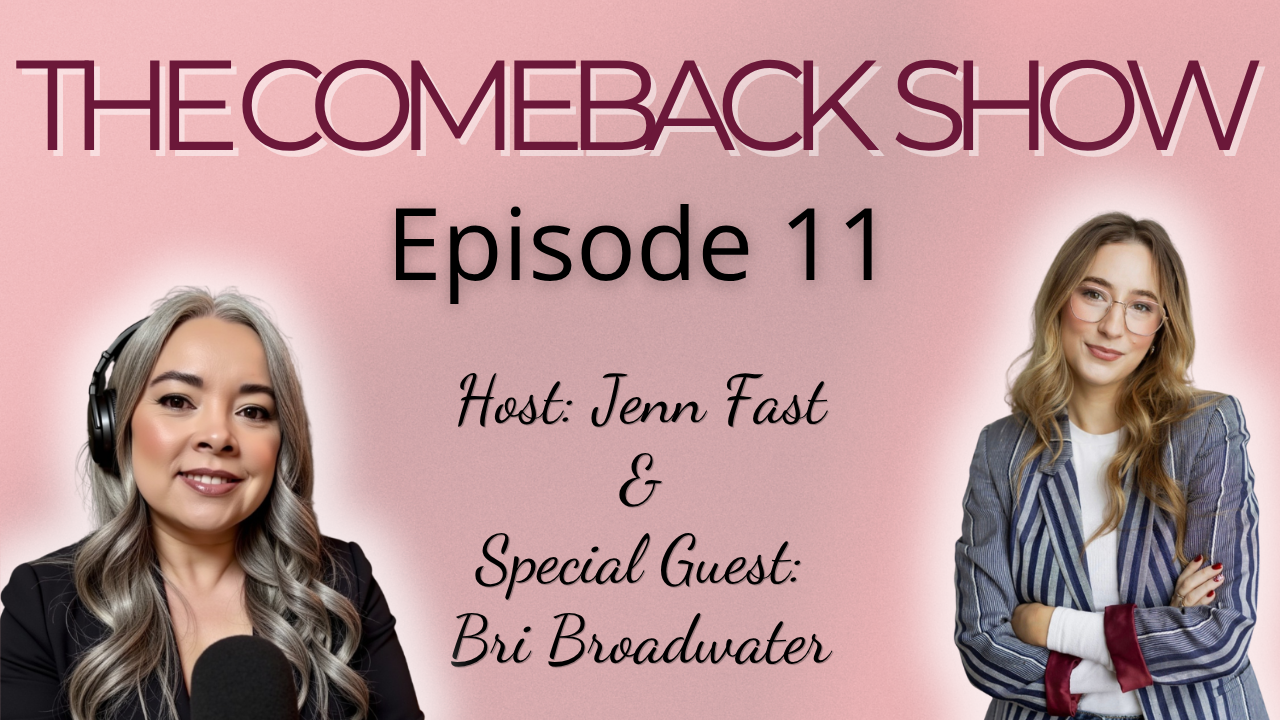
This one is part of the Reinvention Stories thread, where I bring you women who are in the middle of the brave thing and let them tell you the truth about it. Today's story comes from my conversation with Bri Broadwater on The Comeback Show, and it cracked something open in me I'm still sitting with.
The question I had been swallowing for days
Last month I sat next to my husband in his hospital bed, as he prepared for his second spinal surgery in three weeks, and I asked him the question I had been holding in my mouth like a stone.
"Do you need me to go get another job? Because I will, if you need me to."
I asked it like a wife who meant it, because I did. I also asked it secretly dreading the answer.
Nine months ago I walked out of my corporate biotech job with no plan, no nest egg, and a deep, electric certainty that I could not stay one more day. The plan was to build something of my own. And then my husband, who owns a roofing company, fell at home. Two surgeries later, I was looking at him and quietly bracing to put a corporate badge back on and pretend the last nine months had been a sabbatical.
He said no. He said please don't. He said we will figure the money out, your health and our family matter more.
I exhaled in a way I am honestly still metabolizing. Because here is the part of starting over that almost nobody writes about: someone in your life is usually carrying more than either of you planned. The leap is rarely solo. The story we tell about the leap is.
Meet the woman who is "allergic to flop"
I thought about that bedside conversation through the entire edit of this week's episode.
My guest is Bri Broadwater, founder of Noli Coffee in Bothell, Washington. She funded the whole thing with savings, sold stock, and wedding gift money instead of a loan, after being laid off twice from tech in 18 months. She is about to turn 32. I am 52. We are technically a generation apart, and that turned out to be the most interesting thing in the room.
Bri's brand mantra is "allergic to flop," and it is exactly the energy I needed the week we recorded.
She was laid off from Salesforce in 2024. Laid off again from a short tech contract in 2025, one that was supposed to last a year and ended after a few months. That second one is the one that stung. It is also the one that let her stop pretending she wanted to go back.
So she found a $10,000 coffee stand for sale on Craigslist, showed up the next day, met the owner, and said the words: "I'm interested. I want to go for it."
She named it Noli, short for nolite timere, Latin for "have no fear."
The part Instagram skips
Here is what I love about Bri, and why I asked her on the show.
She builds her business in public on TikTok. Not the polished, filtered, everything-is-thriving version. The real one. She made a video called "Saving Ourselves From Destitution." She has talked about the day she sold one single cup of coffee and thought, in her words, "oh, shit, this had better work."
And on the show she said the thing out loud that so many women quietly carry: her business is profitable, but she is not back to her old six-figure salary. Her husband, a 100% commission mortgage lender, is carrying more financial weight than either of them planned.
She wanted to talk about that on the air. Because, as she put it, that is the part that gets skipped on Instagram.
It is. And I refuse to gaslight you into thinking it is incidental.
Both of our households are running on one full income right now. Both of our husbands are quietly doing more than they signed up for. The financial reality of going from a corporate salary to building something of your own is not a footnote in your reinvention story. It is the story. The conversations you have at home are the foundation everything else gets built on. Pretend otherwise and you are building on sand.
If you have ever sat across from someone you love and tried to do the math out loud, I want to hear about it. Hit reply, or come find me in the comments, and tell me what that conversation was like. You are not the only one who has had it.
What it actually costs, and what it quietly saves
When Bri described the gap between profitable and her old salary, I told her something I only fully understood after a financial reporter interviewed me about leaving corporate.
I had been so focused on the salary I gave up that I almost missed what the job had been costing me.
We crunched the numbers. Our family is saving roughly $53,000 this first year just from lifestyle shrinkage. No commute. No bridge tolls. No parking. No corporate wardrobe. No convenience dinners ordered at 6 p.m. because I was too wrung out to cook. No breakfast and lunch bought out because I never had the time or the working memory to pack them.
People weighing the leap obsess over the salary they would lose. They forget to count what the job was quietly charging them every single day to keep it.
That does not make the gap disappear. Bri and her husband are both grinding hard. She has barely traveled this year after a year of weddings and trips. But naming the real cost, and the real savings, is how you make a decision with your eyes open instead of your fingers crossed.
Bri's actual advice for the woman without a safety net
I asked Bri the question that matters most, because not every woman has a supportive partner with a steady income. What would she tell someone staring at the same leap, alone?
She did not hand out a fantasy. She handed out a plan.
Look at your real funding options. If you have good credit and a solid business plan, an SBA loan or a bank loan is not a failure, it is a tool. Don't be afraid to borrow, just be thoughtful about it.
Lean on the people who can actually support you. She said she would not be above moving home for six months to cut costs and go all in, and that supportive families tend to understand that.
And if neither of those is available to you, build your runway longer. Keep the job you hate if you can see the light at the end of it. Build the bones of the thing at night, an hour after dinner. Start the popup version. Get to one farmers market. Run the e-commerce shop as a second job. Grow your side thing until it is big enough that you can walk away from the lame one.
Make it your second thing first. Then make it your only thing.
The generation gap that turned into a gift
This is the part I keep replaying.
Bri is 32. I am 52. I went in assuming she had all the advantages, the tech fluency, the energy, the decades to recover from a mistake. And she has those. There are a million more resources now, a YouTube channel and a course for everything, though she was quick to note that wading through the bad advice is its own full-time job.
But then she said something that made me a little emotional.
She talked about how her grandmother rose to senior accountant at a chemical company during World War II, and lost the job when the men came home. About how our grandmothers could not get their own credit cards. About how far women have come in just a couple of decades, that we get to choose corporate, or entrepreneurship, or staying home, on our own terms.
And I realized the older woman in that conversation was not the one at a disadvantage. I have the pattern recognition. I have less ego, because I have lived long enough to know almost nobody is thinking about me as much as I fear. I know which fights are worth it. I have the network I spent thirty years building, even the parts I almost walked away from thinking I didn't need them anymore.
When women stop competing and start teaming up across the age lines, magic happens. Bri does not see the other local coffee stands as her competition. She sees Starbucks and Dunkin. There is room for all of us. I believe that more at 52 than I ever did at 32.
This is not cheating. It is strategy.
Near the end, we landed on the same place from two different decades: the systems that let you keep going.
I told Bri about the workflow I built in Claude Cowork for my podcast, the one where I type a single keyword and it asks me the recording date, the guest, the air date, and then drops every reminder I need into my calendar so I am not manually building seven events for every episode. My ADHD brain could never reliably do that part. Now it just happens, and the energy I save goes into the conversations, which are the part that actually matters.
Bri is doing the same thing in her own way, using AI to draft the HTML for her website, the kind of task that used to eat a week and now takes an afternoon.
Here is the reframe I want you to take with you. Using support, whether that is a tool, a mentor, a partner, or an organization like SCORE that matches you with a free advisor, is not cheating. It is not a shortcut. It is strategy. You are not less of an entrepreneur because you got help. You are a smarter one.
You deserve the support. Especially if your body, your brain, or your bandwidth does not always cooperate.
Where to start, if you are where we were
If you are sitting on a leap you are scared to take, do not start with the business plan. Start with the conversation.
Sit down with the person whose life this will touch, and tell the truth about the money, the runway, and the fear. One honest conversation at the kitchen table will do more for your reinvention than a hundred saved Instagram reels.
That is the one thing. Just the one.
Come sit with us
If this made you feel less alone in the middle of your own leap, that is the whole point.
Listen to the full conversation with Bri on The Comeback Show [listen here →]. If you are a Seattle-area local, drive up to Noli Coffee in Bothell and tell Bri I sent you. Order the Diet Cherry Coke espresso. It is allegedly semi-viral and I intend to find out.
Follow Bri's build-in-public story on [TikTok →] and [Instagram →].
And if you want each new piece like this delivered straight to your inbox, subscribe to The Comeback Letter [join us here →]. No highlight reel. Just the real version, the part most people skip.
A question to sit with
Bri does one hard thing every year. Stand-up comedy. Learning to DJ. Getting married. Opening the coffee stand. Next year, maybe acting school.
So here is mine for you, and for me:
What would your one hard thing be, if you trusted yourself enough to start it?
You do not have to answer today. Just let the question stay with you.
Resources
The Comeback Show: my full episode with Bri Broadwater [listen here →]
The Comeback Letter: subscribe for each new piece [join us here →]
Follow Bri and Noli Coffee: [TikTok →] · [Instagram →]
Seattle area locals can find Noli Coffee at: 10610 Woodinville Dr, Bothell, WA 98011
SCORE: free mentorship matching for entrepreneurs [score.org →]
Thinking about your own podcast? My free Start Strong Podcast Launch Mini-Course [grab it here →]