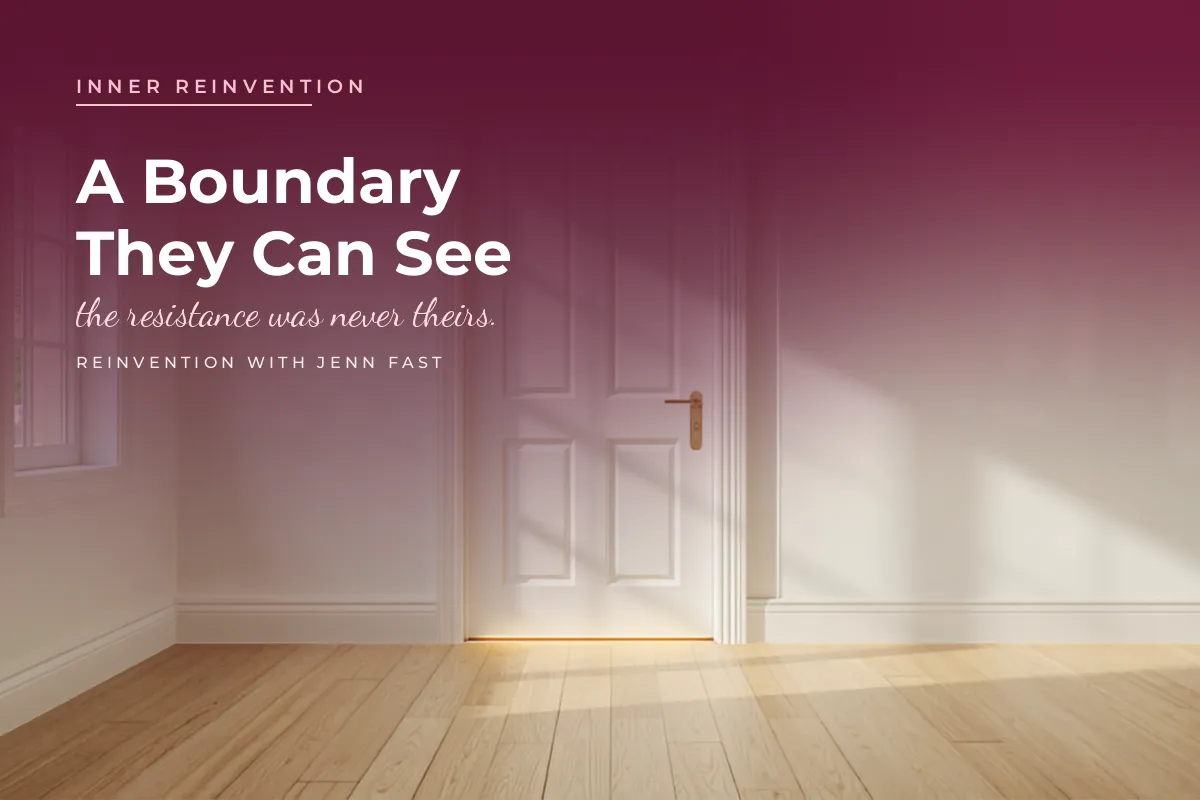
A Boundary They Can See
What thirty years of hiding spots taught me about asking for a room of my own
This article is the companion to Episode 19 of The Comeback Show with Giulia Girelli, founder of Nia Essence and creator of the Return To You method. We covered a lot of ground in that conversation, and I wrote about the identity side of it for The Comeback Letter. This piece is about the one small, physical thing she said that I have not been able to put down since.
Contents
What Giulia asked her husband for
The part that reframed it for me
The sentence I told myself for years
What happened when I finally asked
Why this matters more if your brain works like mine
Where to start, if you do not have a spare room
I had a mezzanine
For most of my corporate career, I had a collection of hiding spots.
At Amazon it was a mezzanine above one of the food courts. Not a conference room, not a phone booth, a mezzanine, the kind of half-floor nobody has a reason to walk through. When that filled up I went to The Spheres and found a bench among the plants.
At other companies it was a cubicle, or my car in the parking garage with the seat pushed back and the laptop propped on the steering wheel.
I want to be clear that I was not slacking off. I was working. That was the whole point. Those were the places I went so I could actually finish something without being interrupted, or so I could have twenty minutes where nobody could put their face in front of mine and start talking.
During the pandemic I finally set up a home office, and that was the first time in three decades that I had a door.
Here is what I understand now, with some distance on it. A hiding spot is not a space of your own. A hiding spot is borrowed. You can always be found in it, and you have to keep quietly justifying why you are there. I was not claiming anything. I was just getting very good at being slightly harder to reach.
That is a different thing, and the difference is the whole article.
What Giulia asked her husband for
On the show, Giulia told me about a decision she made right before her family moved into a new house.
She had a baby who woke every forty-five minutes. No family nearby, no village. She was trying to hold on to a morning routine that mattered to her, and every single morning started with clearing the night before's toys off the floor so she could sit down. So she started cleaning up at night instead. Then her toddler would pull the toys back out at seven in the evening, and she would feel her chest tighten at a two-year-old for being two.
That was the moment she caught herself. Her words: "I can't stress over my kid not being a kid."
So she did something small and very direct. She told her husband that in the new house, she wanted one room that was hers. No toys. Nobody sets a foot in it.
Her daughter can come in for a hug. Nothing comes in and gets left behind.
She calls it her Zen Corner, and she now walks her clients through building one.
The part that reframed it for me
I expected her to talk about the room as rest. Somewhere to breathe, somewhere pretty, somewhere to sit on a cushion and be a calmer person.
That is not what she said. This is what she said:
"Unconsciously this work is a tangible boundary you set in the house, but it's also you teaching yourself and your nervous system that it's safe to set boundaries with the people you love."
Read that twice, because it is doing something clever.
Most of us who struggle with boundaries do not struggle with them at work. We can hold a line with a vendor all day long. We struggle at home, with the people we love most, because there a limit feels like rejection. Saying "not right now" to your own child, or your own mother, or your own partner costs something that saying it to a colleague never does.
So we practice on the hardest case first, fail, and conclude that we are simply bad at boundaries.
A room is the easy case. A room does not require you to say anything. No conversation, no script, no perfect tone of voice. You set it once and then it holds itself, because the door does the work.
And every day that it holds, you collect one small, quiet piece of evidence that setting a limit with someone you love did not cost you their love.
That is not a nice feeling. That is data. And data is something you can build on.
If boundaries are the thing you keep losing, start smaller than a room. The Self-Trust Reset is a free seven-day challenge, one small action a day, built for exactly this: proving to yourself that your own judgment is worth listening to. Get the Self-Trust Reset Challenge.
The sentence I told myself for years
Here is the honest version of why I did not do this sooner.
The house is too small, and there are three other people in it who also need space. It would be selfish to take a whole room for myself.
I believed that sentence completely. It sounded like generosity. It sounded like being a good wife and a good mother, doing the math on the square footage and putting myself last in the ordering, the way I had been trained to.
What it actually was is the same move I have been making my entire life. Take up less room. Do not make it awkward. Do not be the one who needs something.
I was raised in a family and a culture whose message was to be seen and not heard, do not rock the boat, be humble, take up less space. Then I spent thirty years in corporate, the last ten of them as executive assistant to the C-suite, which is a career built entirely on making other people's days run smoothly. That is not a job that rewards you for claiming square footage.
So I did not ask. For years. I went and sat in my car instead.
What happened when I finally asked
Nothing.
That is the part I need you to hear, and it is still the thing that surprises me most about this whole story.
I have never once had to defend that boundary. Not one time. I claimed the space, and my family responded as though it was the most reasonable request anyone had ever made of them. Of course you want a room. Of course you need somewhere to work and think. Why would that be a problem?
The resistance I had been bracing for, the argument I spent years avoiding by simply never asking, did not exist. It had never existed. It was entirely inside me.
And I felt foolish. A little embarrassed, honestly, that I had spent that long protecting three people from an inconvenience they would not have minded in the first place.
If you take one thing out of this article, let it be this. The permission you are waiting for is almost never being withheld by anyone. It is being withheld by you, on behalf of people who have not actually been asked.
Why this matters more if your brain works like mine
I have ADHD, and my office is not decoration. It is infrastructure.
When that room is in disarray, so is my mind. Clutter on the desk, piles on the floor, and I cannot get started. Not "do not feel like starting." Cannot. The thing I need to do is perfectly clear to me and I still cannot get my hands to it.
When the room is clean and it is beautiful, starting is easy. I sit down and I begin. Same brain, same task, different room.
Which is why I push back when someone calls a considered, cared-for space a luxury or a nice-to-have. For a lot of us, the environment is not the reward for doing the work. It is the thing that makes the work possible at all.
I have written before about how you cannot out-discipline a depleted nervous system (read that one here). This is the other half of the same idea. You also cannot out-discipline a room that is working against you.
What is actually in mine
My office is also my podcast studio, so it earns its keep.
There are decorative acoustic tiles on the wall, the kind that read as art and quietly stop the room from echoing. Studio lights. Curtains. A desk that is comfortable rather than impressive. Artwork I chose on purpose. Plants.
Here's a short video of the weekend I spent setting up my space:
And enough clear floor to meditate or do yoga in it, which was not an accident. I wanted a room that could hold more than one version of me.
I keep a running list of what is actually in here, because I get asked often enough (see what's in my space). Some of those are affiliate links, which means I earn a small commission at no extra cost to you. They are things I use every day, not things I was paid to like.

Where to start, if you do not have a spare room
Do not start with a room.
Most women reading this do not have a spare room, and telling you to go find one is the kind of advice that leaves a person feeling worse than when she started.
Start with a surface.
One shelf. One chair with a small table beside it. A corner of the bedroom. The end of the kitchen counter. Something with an edge, so that everyone can see where it starts and where it stops.
Then make one rule about it, and say the rule out loud once, to whoever lives with you. Nothing gets set down here. Not the mail, not the backpacks, not the thing that needs to go upstairs later.
That is the whole practice. One surface, one rule, said once.
It will feel absurdly small. It is supposed to. You are not decorating, you are running an experiment, and what you are testing is whether the people who love you actually mind.
I already know how it is going to go. You are going to be a little annoyed with yourself about the years.
If the room is not really the problem
Sometimes the space is the easy part, and the reason you still cannot sit down in it is everything else.
I recorded a free workshop for exactly that moment, the one where you know something has to change and you have no idea which thread to pull first. It is called How to Find Clarity and Confidence When Life Feels Like Too Much. It is on demand, so you can watch it tonight, after everyone is asleep, in whatever corner you have just claimed. Watch the free workshop here.
Sit with this one
What is the thing you have decided your family would object to, that you have never actually asked them for?
Resources
Listen to Episode 19 of The Comeback Show with Giulia Girelli
Free workshop: How to Find Clarity and Confidence When Life Feels Like Too Much
Free: the Self-Trust Reset Challenge, seven days, one small action a day
Find Giulia at @niaessence.co on Instagram
Related: You Cannot Out-Discipline a Depleted Nervous System


