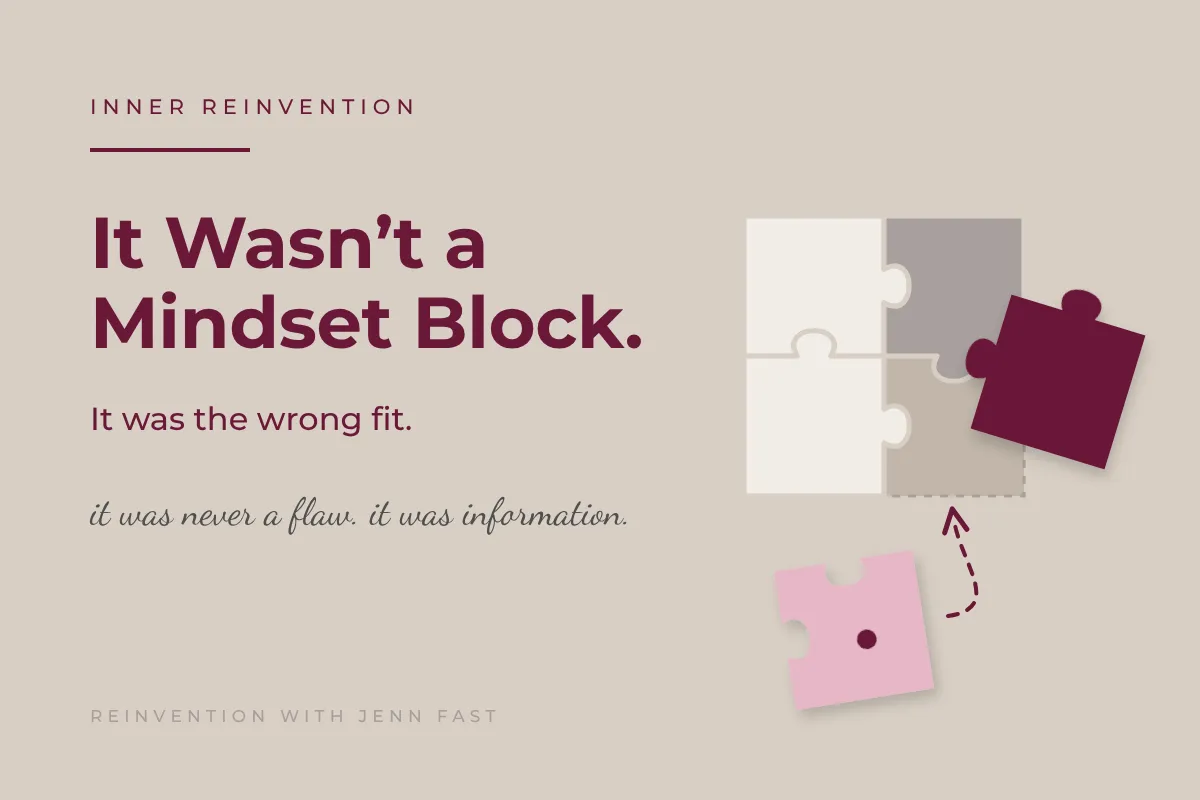
It Wasn't a Mindset Block. It Was the Wrong Fit.
What one unfinished workshop, three brands, and an expensive accelerator taught me about the strategies I kept blaming myself for
This article is the companion to Episode 23 of The Comeback Show with Daire Paddy, an ADHD and Autistic online business coach in Nottingham, England, who works with what she calls "very creative, slightly chaotic entrepreneurs." I wrote about her 1,001 ways line and her minimum daily essentials in The Comeback Letter. This piece is about one sentence she said almost in passing, about the words we use on ourselves when something isn't working, and why I stopped using them.
Contents
The workshop I couldn't finish
How I ended up doing someone else's homework
The part I was actually avoiding
Why the wrong fit costs ADHD brains more
The workshop I couldn't finish
The workshop was supposed to be the easy part.
I had the program. I had the outline. And I had a business accelerator I'd paid good money to, telling me exactly how to launch it: a live workshop, on a set date, in real time, with people watching.
So I sat down to finish it. And then I didn't.
I put it off. Then I put it off again. Every other task on my list suddenly looked more urgent. The workshop sat there, almost done, for far longer than it should have.
And I did what so many capable women do when we can't make ourselves do the thing.
I assumed the problem was me.
The words we use on ourselves
You probably know the vocabulary. Fear of visibility. Self-sabotage. Resistance. Imposter syndrome. Not enough discipline. Not believing in yourself enough.
There is an endless supply of these words, and when you're stuck, it is very easy to pick one up and use it on yourself.
Daire knows that vocabulary by heart. She spent a long stretch trying to follow the one-signature-offer model, with a coach she had invested heavily in, and she was miserable. She described the business she'd built for freedom starting to feel "like a prison." And for a long time, she assumed the misery was a flaw in her.
"I thought that I had limiting beliefs. I thought I was resisting success, all of these other mindset-y words that we use on ourselves to talk us out of listening to our intuitions."
Read that last part again. Words we use on ourselves to talk us out of listening.
That is exactly what a mindset label can do. It takes a signal, the part of you saying this doesn't fit, and turns it into a character flaw you now have to fix. And once it's a character flaw, you stop asking whether the strategy was ever right for you in the first place.
How I ended up doing someone else's homework
My workshop wasn't the first time I'd tried to squeeze myself into someone else's model. It was just the moment I finally noticed.
A couple of years ago, I gave in to all the influencers telling me I needed to niche down. The trouble was, I'm multi-passionate, and I didn't know yet that I have ADHD. So I did the most me thing possible. I niched down three times.
Three brands. Three very specific niches. And it sort of worked. Each brand grew. But I was doing the work of three people to keep up with all of them. If you read Spared, Then Buried [read it here →], you know that wasn't the first time I'd carried three people's workload. I had simply rebuilt it inside my own business.
Then I paid good money to join a business accelerator that taught one thing: the single signature offer model, the same model Daire and I debate in the episode.
Narrow your niche, define your ideal client, build one offer, launch it.
I followed it exactly. I was the gold-star student.
I did not get the same results.
Daire described this so precisely it made me laugh out loud:
"You can be following the homework to the letter. You can be, you know, like getting out your gold star, high achiever student badge out and really committing and still not see any momentum and still not see any results, while Sally Sue over there is absolutely killing it."
And then she said the part I wish someone had told me years ago.
"That's not because there's something wrong with you. It's because that strategy specifically maybe just doesn't gel with the way your brain works or the way your business works."
Some good did come out of that season. I realized my three brands had quietly grown toward the same woman: a midlife woman like me, in the middle of a big life transition. So I brought them back together as Reinvention with Jenn Fast, and that one change cut my workload by two-thirds.
But the method itself? I was still forcing it. I just hadn't admitted it yet.
The part I was actually avoiding
Back to that workshop.
What finally broke the spell wasn't a breakthrough or a pep talk. It was a plain, slightly embarrassing realization.
I wasn't afraid of my offer. I wasn't afraid of being seen. I hated the idea of doing it live.
That's it. That was the whole "block."
So I stopped trying to fix myself and changed the strategy instead. I switched to an evergreen recorded workshop, one I could make on my own terms and that women could watch whenever they're ready.
It was the right call for me. The procrastination was never a character flaw. It was information, and I had spent far too long arguing with it.
Daire put the whole trap into one sentence:
"If you are forcing yourself to follow through with something that you objectively hate, that gives you anxiety, that, you know, you procrastinate over because you just don't enjoy it... then of course you are not going to see the results."
Of course. Not because you're broken. Of course.
Have you ever been the gold-star student who did everything right and still watched someone else get the results? I'd love to know what the strategy was. Leave a comment or hit reply. I have a feeling the list is going to be long.
Why the wrong fit costs ADHD brains more
I want to name this part plainly, because I think it's where so many neurodivergent women get stuck for years.
Executive function is your brain's command center: the set of skills that helps you start tasks, plan, focus, manage your time, and handle your emotions. Every strategy you follow runs on it.
A strategy that fits your brain still takes effort. But a strategy that fights your brain costs extra. You spend energy just getting started. You spend more managing the dread. You spend more again overriding the part of you that keeps saying no. By the time you reach the actual work, the tank is already low.
For me, when my ADHD meets a strategy that isn't aligned with my values and my capacity, the result isn't just procrastination. It's nervous system dysregulation and real emotional distress. Sometimes I feel it right away. Other times it takes a while to notice, and by then I'm well down the wrong road.
That's exactly why mindset labels can do so much damage to brains like ours. When you call that distress a block, you try to push through it. Pushing through a mismatch spends the very executive function you were already short on. So you get more stuck, and you blame yourself harder. Round and round it goes.
If you've been calling something a block for months, it helps to know where your brain is strong and where it needs support before you decide what's wrong with you. That's exactly why I made the free Executive Function Self-Assessment. It takes a few minutes, and it shows you how your brain actually works, so you can choose strategies that fit it instead of fighting it. [Take the free Executive Function Self-Assessment →]
This isn't quitting. It's choosing.
I know the voice that shows up right about now. The one that says changing course is what people do when they can't hack it. That serious women push through.
So let me be clear about what this is not. It is not a case against signature offers, or niches, or any one strategy. Daire is the first to say the single-offer model works beautifully for some people: "I've seen people get amazing results from having one signature offer." She isn't against strategy. She's against pretending one strategy fits everyone.
I did launch my signature offer. And I learned something I could not have learned any other way. I will never be happy with a constantly launching model. I want to offer different programs for the different women I serve, because they don't all need the same thing at the same moment.
So I made a decision. I'm no longer paying other people to teach me their methods. I'm building my own business model, one that fits the way my brain and my capacity actually work.
That isn't giving up on growth. It's refusing to grow in a shape that hurts.
And this isn't only a business lesson. The same pattern shows up in the workout plan you dread, the morning routine everyone swears by, the planner system that changed your friend's life and does nothing for yours. When the thing you "should" do keeps not happening, the question isn't always what's wrong with you. Sometimes it's what's wrong with the fit.
How I check the fit now
I don't get this right every time. But I catch it much faster than I used to, and it comes down to three things.
I know my executive function before I choose. Understanding my strengths and limitations in advance means I can see a mismatch coming. If a strategy depends on something my brain finds expensive, I know that going in, and I can adapt it or skip it before I've invested months.
I use the two-door test. When a decision feels big, I use a practice my therapist taught me, which I wrote about in Your Body Sends the Bill [read it here →]. I imagine the yes as if it's already decided and notice what my body does. Then I do the same with the no. Then I compare the two bodies, not the arguments. My body usually knows about a mismatch long before my brain will admit it.
I don't argue with myself anymore. This is the biggest change of all. When I notice the distress, I don't spend weeks trying to talk myself out of it. I give myself permission to change course before I'm too far down the path in the wrong direction.
Planning a year that fits
This is the season when a lot of us start planning next year. New goals, new systems, the shiny new strategy everyone is suddenly talking about.
I did my 2027 planning in the first week of November this year, which is early for me. It was also the clearest planning I've ever done, because I had a full year of lessons behind me and a very clear understanding of my values and my capacity.
I can already tell next year will be more aligned than this one. Not because I plan to work harder. Because I expect to spend far less time making mistakes and recovering from them.
That's what fit gives you. Not a perfect year. A year with fewer detours.
Where to start
Don't overhaul your plans. Pick one thing.
Choose the strategy you've been procrastinating on the longest. The one you keep calling a block. Then ask yourself one honest question:
If nobody had told me this was the right way, would I have chosen it?
If the answer is no, you don't have to throw the whole thing out today. Just look for the specific part you're avoiding. For me, it wasn't the workshop. It was doing it live. Very often it's one piece, and changing that one piece changes everything.
Something to sit with
What have you been calling a block that might really be a bad fit?
Resources
Listen to my full conversation with Daire: There Are 1,001 Ways to Do This Thing [listen here →]
Find Daire on Instagram at @dairepaddy, listen to her podcast Stacked and Steady, and join her free monthly Bold Moves Telegram drops at dairepaddy.com/boldmoves →
Take the free Executive Function Self-Assessment and see where your brain is strong and where it could use support: reinventionwithjennfast.com/executive-function-assessment-optin →
Want the whole toolkit? My book Executive Function Unlocked [on Amazon →], and the self-paced Executive Function Unlocked course [teachclub.com/@executivefunctionunlocked →]
Read next: When Doing Everything Right Stops Working [read it here →] and Who Are You Still Performing For? [read it here →]
Get a new Comeback Show conversation every other week in The Comeback Letter: subscribe free →


